Blue Tongue

The Culicoides biting midge. Also know as no-see-ums because they are hard to see with the human eye. The Latin word, Culicoides is uninteresting. It simply means, gnat. A small and bothersome bug. There is no grand etymology to that word that leads me or you down any interesting rabbit hole of language. But perhaps you can do something more with gnat than I can. I am going to leave the word alone, turn away from it like I’m giving it the silent treatment.
The biting midge carries a particular disease that it passes to ruminants — mostly sheep, but also cows and goats. A ruminant, and this is very interesting etymology, comes from the latin word, ruminare which means, to chew over. In the English language, it has come to mean two things:
A hoofed mammal that chews its cud regurgitated from its rumen
A person given to meditation
It’s no coincidence that often our cows exhibit both behaviors. When they chew their cud, they also seem to meditate. They stare long and calmly out at the horizon, accessing some depth of contentment that I have not yet been able to replicate. If you move close enough to their mouths, you can smell the scent of regurgitation. It isn’t as fowl as it sounds. It smells vaguely like rancid garbage but enough like grass that you can stick around for the smell. It’s actually, kind of nice.
The Culucoides biting midge passes a virus called, blue tongue to their chosen ruminants. The virus damages blood vessels, causing swelling and in the case of our dairy cow, an extreme swelling around the mouth and nasal passages. The first case of blue tongue was reported in the late 1800’s in northern Africa and as livestock were transported overseas, the virus traveled with it.
Blue tongue is not so common in dairy cows and it’s not common at all in the high desert where we live at almost 8,000 feet. In fact, our vet had never seen a case like it in a dairy cow. When we called in for a second opinion with a vet who lives in Minnesota and has been working with dairy cows for fifty years, he said he had also never seen a case of blue tongue like it in a cow. The virus is most common in warm, tropical regions where this particular kind of midge lives and thrives.
Our cow did not get blue tongue here on our farm — she came with it.
When we bought Rose, our very first dairy cow, we bought her off of craigslist. You may think this is an irresponsible way to buy a dairy cow but craigslist remains a reliable way to buy livestock. Most farmers are a couple of technological decades behind whatever platform the mainstream culture is using.
Rose was listed for two thousand dollars, an average price for an unvaccinated dairy cow and an even better price for a cow that was bred and due to calf in the spring. The farm that was selling her was in Oklahoma. They told us she was a good milker with a solid udder. They told us she had successfully birthed one previous calf. They told us she was well-mannered and friendly. These sounded like strong dairy cow qualities and ones we were interested in.
We had no horse trailer to go and pick up Rose with. Even if we had one to hitch to the back of our truck, we couldn’t drive it. I had tried to drive one once and had jackknifed the back of our truck pretty badly, having to drive the rest of the way home while avoiding putting the truck in reverse.
When Rose arrived on our farm, she was thin. Her hip bones jutted out to the sides like defined scapulas. When we sent photos of her to our friends and family, they replied,
Is she supposed to be that thin?
We didn’t know. We had never had a dairy cow before. Because of Rose’s thin frame, we doubted her pregnancy. Could she really be six months pregnant? Everything we read about pregnant dairy cows said they should look like a round orange standing on four toothpicks. Rose did not look like that. She just looked like a regular cow. Nothing urgent at all about her abdomen. When I pressed my ear up against her sides, I heard nothing. We tried to reach the ranch we purchased Rose from to ask them if they were sure she was pregnant, but we couldn’t reach them. Their website was gone. Their phone number, disconnected. It was as if they had never existed at all.
The very real and practical thing about selling a cow, is that you never sell a great dairy cow. It’s spiritual law. It would be the same as killing a mockingbird. You hold on to your great diary cows. The great dairy cow gives you cream and butter and cheese and kefir and milk and ice cream. The great dairy cow is relatively independent. She doesn’t need much from you. She prefers to stare out blankly into the distance — meditating, chewing her cud, meditating, chewing her cud.
But there is always a reason to sell a dairy cow. And the reason is never that she is great. The reasons can be varied — anything from temperament to a bad udder to tendency to infection. Rose did have very small back teats — hard to milk and hard for her calf to suckle from. She also had had infections on and off since we got her. The tiny no-see-um at work. The Culicoides biting midge. The bizarre tropical virus — growing inside pools of stagnant cattle yard urine.
Like trying to explain why a nineteen-year old dies suddenly in a car crash, one tries to find a reason for the declining health of their dairy cow. It isn’t fair and it doesn’t make sense. God is not on your side when your dairy cow is unwell. In fact, there may even be a godless place called, Oklahoma that is responsible for the decline of your dairy cow. The Culicoides biting midge is much more likely to live and thrive in a hot and low elevation climate like Oklahoma.
Like I said, our cow did not get blue tongue here on our farm — she came with it.
When I heard of a neighbor who had run out of hay for his cattle and in the interim, had given them large amounts of corn mistakenly sending them into fatal acidosis, I felt relieved. He lost two of his cows, wasn’t able to save them. When cows eat too many grains, it throws off the balance of their rumen and they start to bloat. It’s hard to bring a cow back from that. The farmer made a mistake, we all do it. But somehow, when our dairy cow is sick and really, when any of our animals are sick, I cannot help but feel that it is some moral shortcoming of my own that I am not able to help them, fix them, bring them back. I blame myself. I need to hear stories from other farmers. I need to hear about how they messed up, got it wrong, make mistakes. I need to hear that we are out here on this land doing our best and even still, our animals get sick and they die. That perhaps it isn’t just me. Perhaps I’m not bad at taking care of cows. Perhaps it’s just that animals get sick, they break their legs and they get mysterious tropical viruses that don’t go away. Perhaps there are many things that are actually out of my control and that feels the most relieving of all.
What if the farm in Oklahoma had not told us the real story as to where Rose came from? Perhaps Rose has a story that, if we could hear her tell it, would bring us to silence, drop our mouths open and deepen our gaze. In my greatest fantasy of Rose, she’s actually a cow that hails from Mexico — wandering her way through lush jungles and foreign landscapes, reaching her neck up to eat the wide leaves of a fig tree and stretching her tongue outward to catch a banana, eating it peel and all. Perhaps she ambled through the jungle with her herd feeling confused as to her place in the world. What was a cow — who came from the salty shores of the Channel Islands, somewhere between England and France — doing in the humid terrain of Mexico?
I imagine that Rose was born as a small, patchy calf somewhere on the Pacific coast of Mexico. Where the summers were too hot for her and where she envied the brown humans who laid on their porches with wet towels over their faces and abdomens. She was never meant for humidity like that. She would sweat through her hide, smelling earthy and salty. Like a healthy soil that you want to taste. I imagine that she watched the rains fall in January, making for muddy hoof prints in the sand. I imagine her separated from her mother early and soon, creating a kind of loss and longing inside of her that made her prone to homesickness. I like to imagine that she lived on a ranch in Mexico and because she was always a very submissive cow, she didn’t force her way into the trough, she didn’t demand food. She waited patiently for anything left over. She laid down in the sun while the others ate. She chewed her cud and meditated on another kind of home.
And then one day, perhaps she grew tired of the dense heat that encircled her like a heavy fog and she knew she had to go. She knew she had to head north on a long, skinny train. And that long, skinny train would take her to a place that she had heard about. She had heard the other cows in the herd whispering, not to her of course because she was mostly a loner cow, but to one another. About the great and arid plains of Oklahoma. She started to dream about a place where the summers were more hot than moist. She also heard that tickets were cheap. But she wouldn’t even buy a ticket, being a cow and all. She would simply make a walk toward the train in the middle of the night and make a mighty leap onto one of the red metal cars near the back of the train. She would lie down, silently and meditatively because that was her way, and she would ride all the way to Oklahoma. She would ride through the Chihuahuan Desert, where the strange yucca plant would bloom over her head and she would smell sage brush for the first time. And when the train stopped in Oklahoma, unloading great piles of lumber and steel, she would saunter off as well. Finding her way to a new herd, to the smell of her own kind. I believe this is how Rose came to live on a ranch in Oklahoma. This is the story I think she would tell.
Perhaps, like me, Rose is an immigrant, traveling great distances to live in a place that is nothing like her original home.
Thinking of Rose this way, makes me want to help her get home — back to the original environment she would thrive in. This is a fantasy I entertain when I want her to be well. When I think that the thing that would cure her would be to return her to the environment she was meant to be in. After all, place matters in that way.
I imagine that I would return all the Jersey cows back to where they came from. I would put them on a very romantic passenger ship headed east. They would hate it at first because they would be crammed together and they would have to stand in their manure for a couple weeks, but they would smell the ocean and the salt and they would start to remember. Something in their hide would start to twitch. Their great, black noses would start to sweat. They would sigh, settling into their spines, and regurgitate their cud. They would chew and chew, meditating now on the moving horizon of the ocean. After twenty-one days, and after having run out of all our hay storage, we would dock on the island of Jersey, of course. One of the Channel Islands that sits eighty-five miles south of England, the southernmost island.
You may think it too obvious that the island the Jersey cow originates from is called Jersey Island. The island was not named for the cow, but rather the cow was named after the island, after a Scandinavian local leader who took over the island during the Viking age. Jersey Island sounds more like Pleasure Island from the 1940’s Disney film, Pinocchio, adapted from an Italian children’s book. Pleasure Island was the place little boys went to indulge in anything they liked — candy, games, mischief. But as soon as they misbehaved, they were transformed into donkeys who would be forced to work the rest of their days out on the island. The Italian version of hell.
Back on the ship, our bellies would be full from all the milk we would have be drinking during the voyage, our calves rounded from the cream. We would pull the boat up to the shore, with the green rolling hills in the distance, and the cows would begin to shift on their hooves. The deck would be slick beneath them with urine and the leaking of their udders so there would be the risk of them getting too excited and slipping. When we opened the bridge that would extend from the boat to the shore, we would watch the horizontal pupils of their eyes dilate. Their hooves would begin to clap and dance, making a metallic rhythm on the deck of the boat. And then, they would run. They would run for the shore, over the bridge and for the grass, for the salty edges of the rock. They would run home.
There is a relief in returning an animal to its rightful place. It would be similar to turning on the great music of Judy Garland and watching your blind grandmother recognize her voice. A glimmer of who she used to be in her eye, and who she felt she still was. It always feels good to bring someone home.
*
A few weeks ago, our vet came out to our farm and took blood samples from Rose in an attempt to figure out what her swollen lips meant. Weeks later, when he came out again — the cows now able to recognize his large, red Dodge Ram truck — he stood in the mid-morning fall light and told us the blood results had come back positive for blue tongue. He would have to report the case to the state — it was veterinary law. He shook his head and said,
I would have sworn it was leukemia. I was really betting on that. Sure surprised me that it came back as blue tongue.
What can we do for her? What’s the treatment? I asked.
I already knew there was nothing he would say that would mean much to us. But I also knew that I needed to pretend like his opinions were important to me, that to me, he was an important authority figure. I knew that in order to keep him coming back to our very rural farm, to incentivize his return amongst all his other clients, I would need to assert myself as the submissive. I would need to make him feel smart.
There’s really not much we can do. We can give her antibiotics after she’s done nursing. Other than that, we just have to watch it. See how it progresses, he said.
Of course we wouldn’t be giving Rose antibiotics. We would be doing exactly what we had been doing for her. And recently, a good friend of ours and a local acupuncturist, had brewed us up a huge batch of Chlorine Dioxide which we kept in our dark pantry in two, half gallon jars. The Chlorine Dioxide is an alternative treatment for livestock that we felt hopeful about. We had been giving Rose three doses a day in a bright red bucket, mixing it in with her oats and molasses.
But even if it was blue tongue. Even if the biting midge had gotten to Rose. Even if there was a virus and a host for that virus and a stagnant pool of urine for the great biting midge to birth itself out of, something still felt mysterious about it all.
Maybe Rose was simply homesick. Maybe Rose remembered Jersey Island. Maybe she remembered the salt and the cold wind that came in off the Atlantic Ocean. Her hide remembered the particles of sand that would lock into her fur, creating small barnacles on her back. Cow’s have really great memories, maybe even lifetimes of memories. They recognize facial patterns. They remember routine and the placement of things in their environment. So I knew that Rose remembered. Of course she remembered.
Or maybe Rose’s body was susceptible to a some kind of infection or inflammation because she held unprocessed trauma in her body. Maybe her nervous system was dysregulated. Maybe she had been through too much. Rose’s first calf was taken away from her when she was on the ranch in Oklahoma, common livestock practice for farmers who are precious about saving their milk. Rose’s second calf died after only four months of being alive and most of that time, the calf lived with us in the house as it was not well enough to be with Rose. Rose now has a third calf who is healthy and growing up with her. I can only hope that something knits it’s way back together in Rose as she experiences raising a calf for the first time. Perhaps a kidney moves a little closer to the sacrum, or the heart nestles in a little more closely to a rib.
Or perhaps, there is more of a spiritual significance to Rose’s presentation of swollen lips. Is there something she cannot say? A story she cannot tell? Or maybe Rose has taken on something for us, a great unspoken burden? Perhaps Rose is urging me to break up the mucous, break up the stagnancy and just say it all.
To say Rose has been a complicated cow would be putting it in a way that I would not mind saying in front of her. It would be polite. It would be merciful. It would not be the truth. The truth would be something closer to the experience of having a crying baby left in a basket on our doorstep. There is nothing you can do but to scoop up the baby and bring it close to you. There is nothing you can do but to instantly become a mother.
Like the first born child, we have made all our worst mistakes on Rose. And like the first child, we are bonded with her in a way where we feel comfortable being alone with her because that’s how it originally was — just the three of us.
Often times, as we’re laying down for bed at night and I have two pillows on either side of me, just before I put my earplugs in, I ask my wife,
Do you think Rose will be okay?
And if I think that is an unreasonable question, I will quickly edit it and say,
Do you think Rose will be okay tonight?
And to that, my wife always says, yes.
I know my wife reassures me so I can sleep, so I can rest easy knowing that in the morning, we will wake to see Rose standing completely still in the barn yard, letting her calf pull and tug on her teats. But truthfully, we don’t know. And holding the reality of that is not something I can do if I’m trying to sleep.
When your dairy cow is sick, and still sick after you have tried everything you know, after all the vets shake their heads and shrug their shoulders, you have to surrender. You have to surrender to the great mystery of the dairy cow. You have to leave it up to Rose. After all, she boarded a long skinny train in Mexico and rode it all the way to Oklahoma.
*****
I love your comments more than anything and also, I write all these essays for free which means, I want EVERYONE to read them. Share these essays with your friends. It means the world to me.
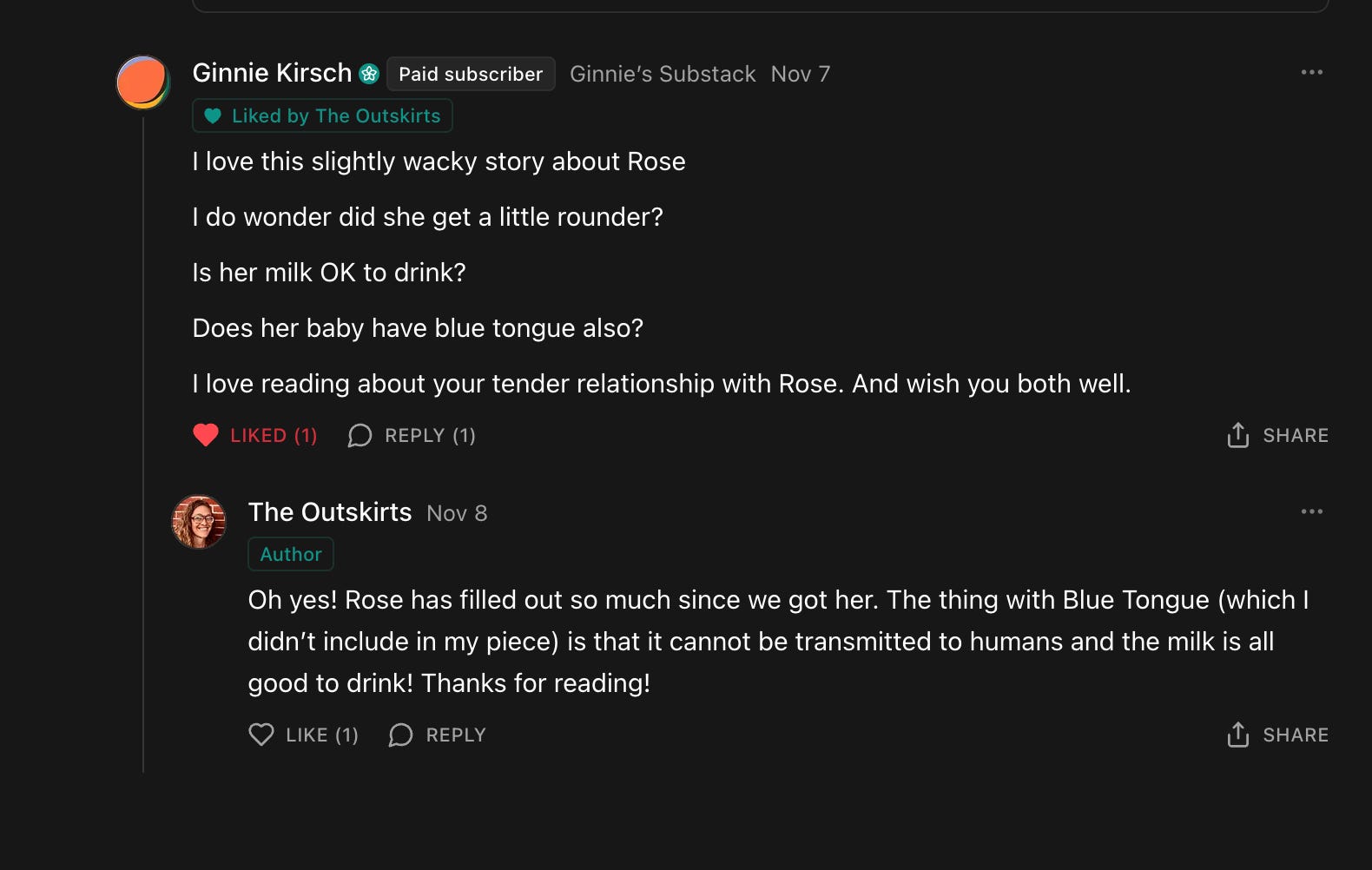
“But she wouldn’t even buy a ticket, being a cow and all.” THIS! This sentence, is perfectly inserted in Rose’s story. It gave me a guffaw of surprised delight, and that is a great way to start a day!