A Mutilated Siren
everyone used to call me, milk legs

The chicken peered at us through the dining room windows while we ate. She did not look away when I returned her stare, a competition igniting between us. I looked away first. “I let her win,” I said to my wife.
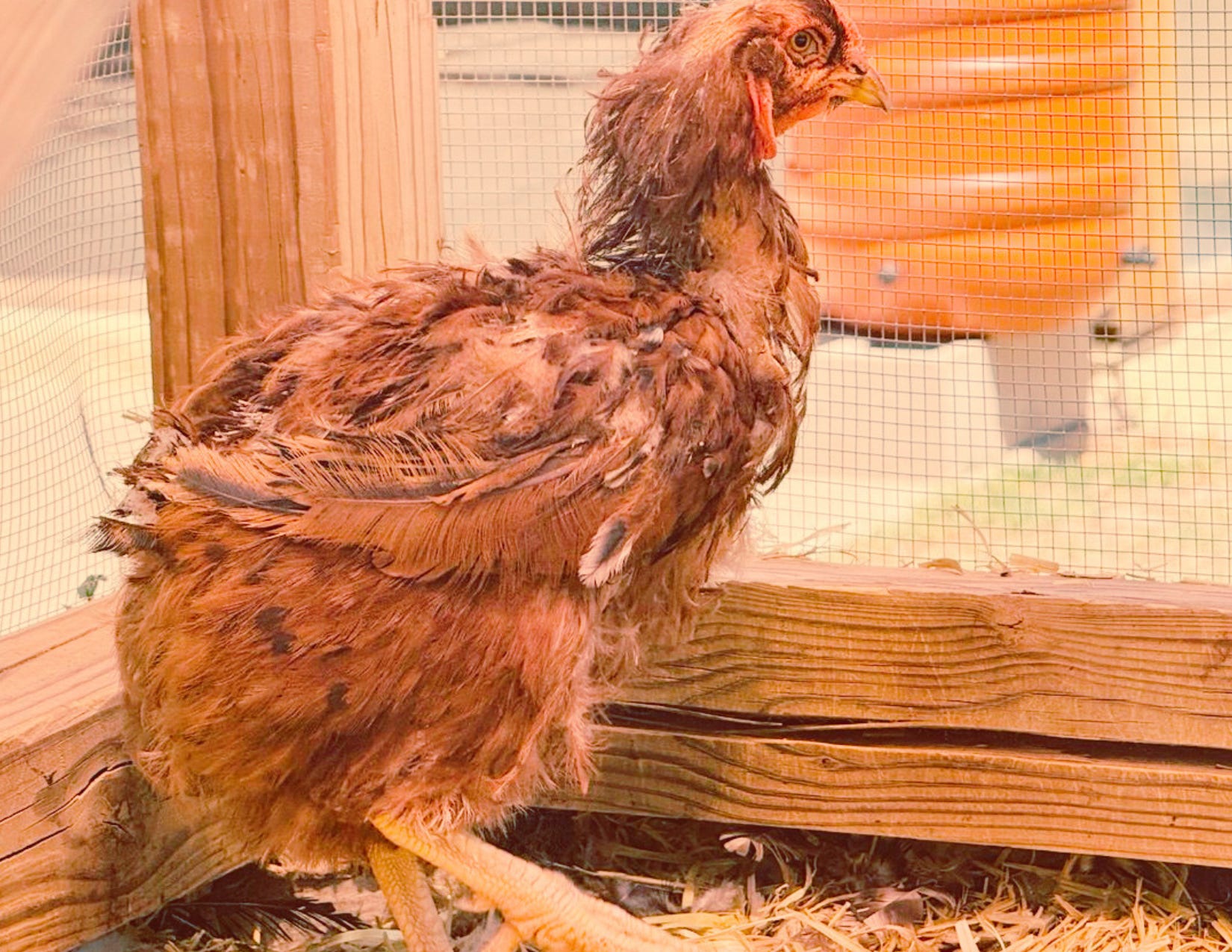
Her head was nearly bald of feathers, leaving a wrinkled skin patch on the top of her head like an old scrotum. Her eyes were hooded with sagging, red flesh and they retreated into the back of her skull. If I had not known this bird’s history, I would have thought she had been badly burned in a coop fire, charring most of her red feathers into a dull black. She was left with pin feathers on the back of her body that stood upright, like a bouquet of porcupine quills.
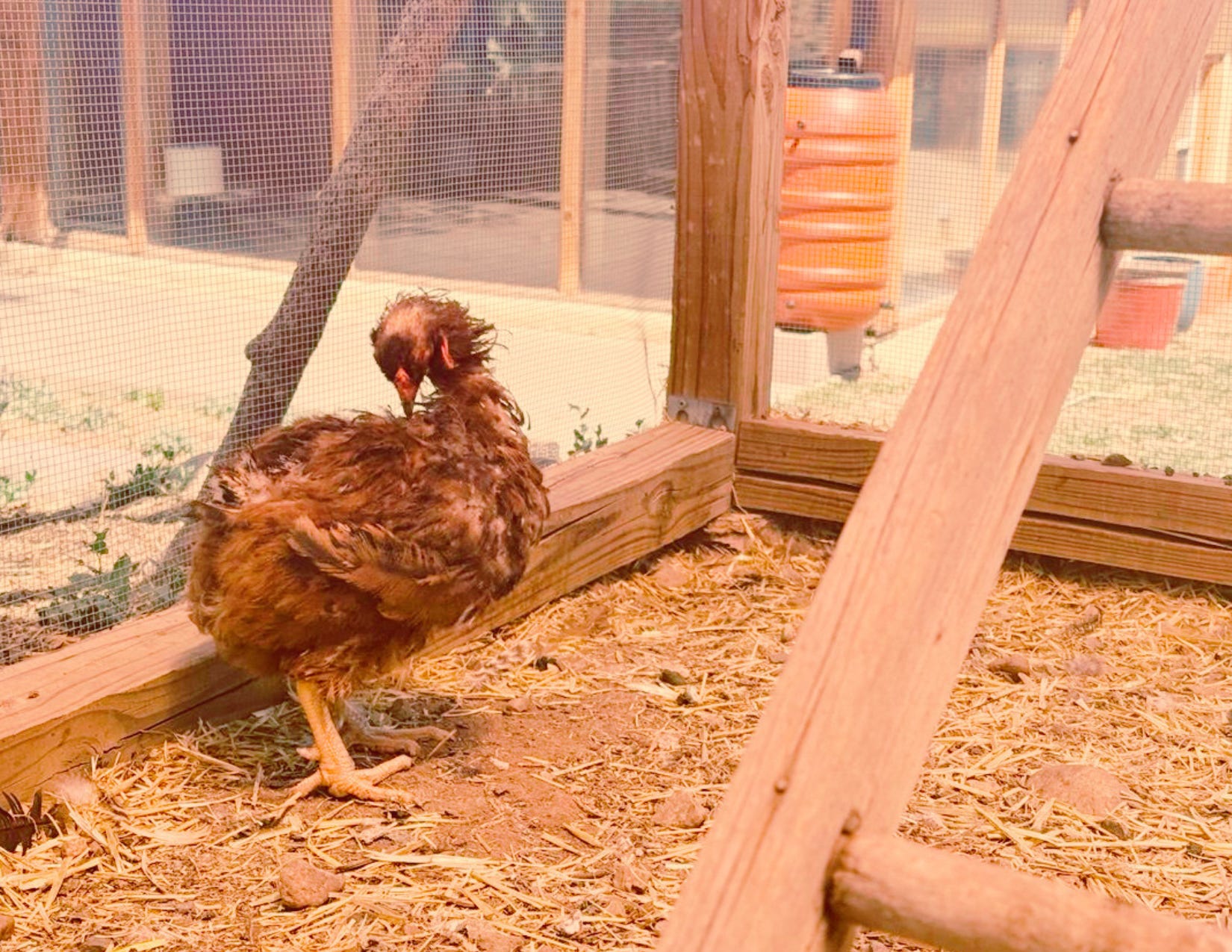
As we ate, the bird preened herself obsessively, biting her way to some kind of relief. We suspected the Northern Fowl Mite, the most common mite in New Mexico, as the cause for her incessant scratching. A mite that clusters under the vent and wings of infected chickens. Mites work by feeding directly on the blood supply of each chicken, like ticks. The Northern Fowl Mite is translucent, marked by a bright red orb in the center of its body, making it look like a combination between an arachnid and a jellyfish.
I would have to hide the bird when my mother came for a visit; the bird would dissuade her from ever returning to our farm. My mother, a former finishing school graduate, used to wield a needle to delicately remove blackheads from my nose, not wanting to scar my face, a careful seamstress of cosmetics. She bought me prescription deodorant to stop me from sweating through my t-shirts, and she reminded me to suck in my belly so it would not sag over the belt of my jeans. As a kid, I watched my mother retreat to her bathroom every evening, close the door, and perform a face-washing ritual that seemed arduous, only in the way that I feared I might have to take up the same mantle of ritual one day. The altar of the ritual was made up of small magnifying mirrors, 500 watt light bulbs, tweezers, Q-tips that she would lick to erase her eyeliner, and a trash can blooming with used Kleenex.
*
The chicken had no idea how ugly she was nor did it seem to be any concern of hers. She was immune to the way her appearance disgusted us but she was aware of her difference, yes. The other birds bullied her relentlessly, pecking at her bare skin, drawing blood from her raw back, and stealing food from her. When we let the chickens out of their coop in the morning, she would huddle under our legs as though she had made it to base during a game of tag.
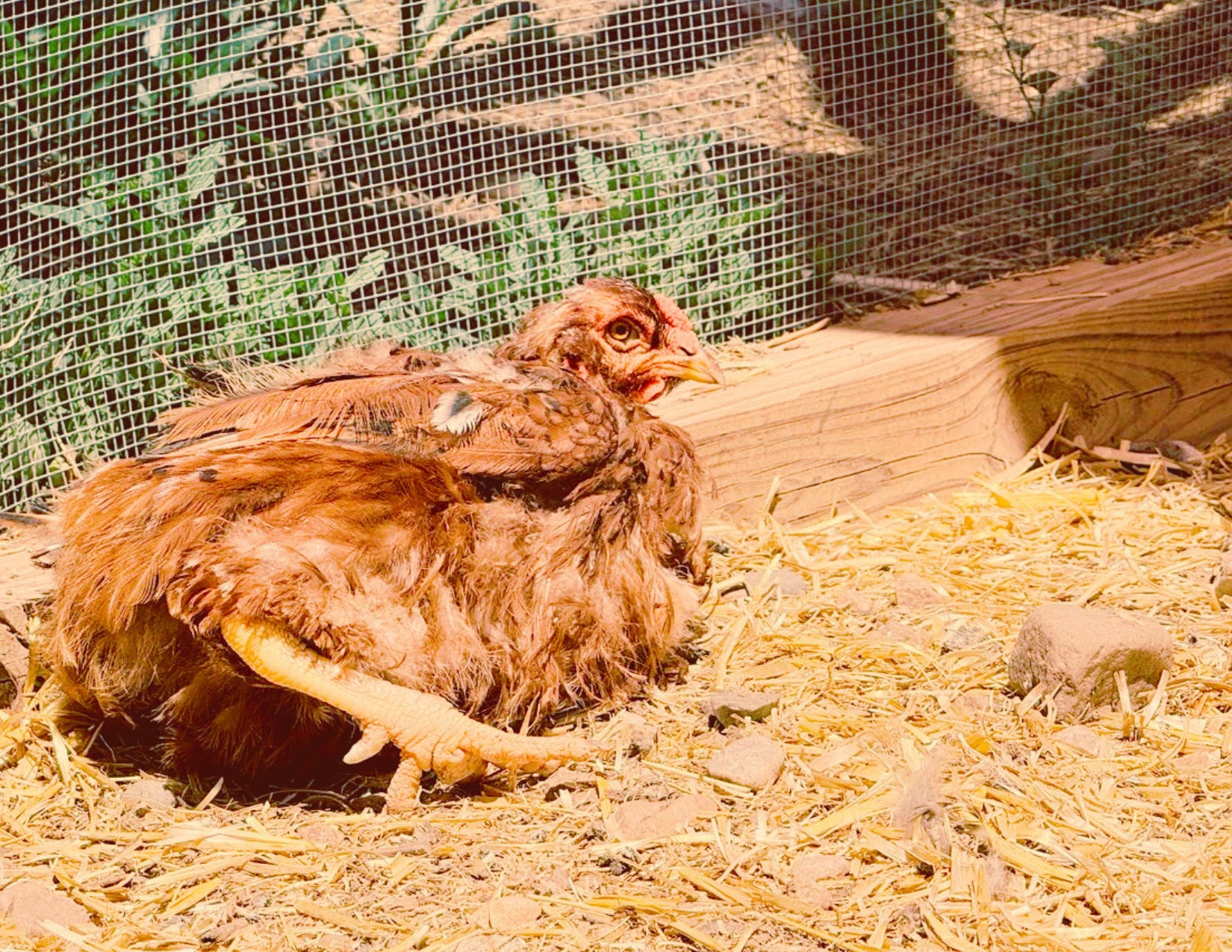
Chickens will sense a sick bird, often before the humans tending the flock notice the sickness. They will socially ostracize the bird so her sickness does not spread to the rest of the flock. Unlike humans, chickens do not other or ostracize out of any moral hierarchy, but out of a desire to protect the continuation of healthy life.
This chicken of ours developed her own survival tactics. She would watch the other chickens run to their piles of food while she waited for me to set down a separate pile in front of her. She would look up at me, fully expecting kindness, unblinking in her reptilian way, and I had to obey. She was a mutilated siren, calling me to her side. I became accustomed to battling off the other chickens so she could eat in peace, shooing them with a large metal spoon and my foot all at once, moving like a human windmill of protection. She knew the requirements for freedom, and never touched our garden or our flowers. She spent most of her time under the bird feeder, pecking at the husks of sunflower seeds the yellow-breasted Baltimore Orioles threw aside.
*
I knew that ugliness deserved to be punished. My father made this clear when he rated women during our weekend lunch outings while I was in high school. The woman who carried an extra ten pounds around her hips, received a 7.5. The woman with small breasts and thick calves, a 6.5. The blonde woman with cleavage that ran through her like it was carving a canyon, received the high score of an 8.5. Red heads were his favorites. Tall women scored higher than short women. More importantly, fashion mattered. Women with tasteful turquoise necklaces and chunky silver wrist cuffs came out on top. The goal was bohemian cowgirl — women who could have stepped out of the latest Sundance catalogue, their pale cheeks brushed lightly with freckles, lips colored with muted, earth tones (absolutely no bold lipsticks), and wrists that swam delicately through the air. No woman (as far as I knew) ever scored a ten.
Before Mrs. Hennigway came to our window at dinner, which is what I had begun to call the bird, we had nearly culled her. It was the day we killed the roosters. As farmers who sold our eggs to the public, I thought it was irresponsible to have such an ugly bird walking around our property. All it would have taken was a small chop of the axe, the quivering of her body as life released. But at the last moment, I hesitated. What harm was she doing in living out her days with us? In a couple days, we would find her anyway, with her eyes closed, her body stiff like a heavy arpeggio, pick her up by the feet and walk her to the compost pile.
But, she didn’t die.
Mrs. Hennigway was not endangering any of the other birds. She was not contagious. Which is to say, her sickness was wholly contained within her own body. It belonged to her and we did not need to take it from her. We discovered, upon picking her up and inspecting her, that she was not being devoured by the Northern Fowl Mite. Instead, she had a large growth on the front of her chest that ballooned out like the vocal sac on a bullfrog. Mrs. Hennigway belonged to the Rhode Island Red variety of chicken who are prone to tumors from poor genetics, getting old (which for a chicken starts around three years of age), and overuse of their reproductive system. Rhode Island Reds are bred for high egg production, thus putting more stress on their hormonal systems. They ovulate more frequently, lay more eggs, produce more estrogen and progesterone. The tumor seemed to most impact Mrs. Henningway’s ability to walk and she jerked her legs up toward her body in a staccato rhythm every time she took a step.
I would need to learn how to tolerate her outward appearance while appreciating her optimistic desire for life. In the most tender of moments, I opened the gate for her to return back into the coop as the sun draped itself over the mountains and watched her as she waited in line at the back of the flock, holding herself a good two feet away from the hens in front of her. Like an anxious mother sending her daughter off to preschool, hoping she would find a kind place in this world.
To love any animal on a farm is dangerous. Loving animals feels more tremulous than loving trees or mountains. Humans outlive their animals, most often, but we die long before the mountains and the rocks. Those staples of nature are our constants while the animals ebb and flow like the rising cicada song in the warming morning. To love Mrs. Hennigway is the most dangerous of all. To engage in her daily rituals alongside of her, to let myself be taken by the cadence of her desire, is downright asking for it. To love something that is sick, that is already showing it’s immortal hand, is to agree to inevitable heartbreak, and soon.
*
I understood that my power in the world would not come wholly from my beauty. I had already cultivated other skills. By the time I was five, I could read whole chapter books and collected prizes from the Burton Bar Library for most books read during the summer. I landed the lead role in our second grade production of Stone Soup, and was the only freshman in my high school to get cast in the musical production of Animal Farm. I played the role of Molly, the singing horse who gets sent off to the glue factory. I made myself useful, developed other skills.
When I was in college, my mother took me to my first Weight Watchers meeting in the basement of the Presbyterian church in Flagstaff where we sat in the windowless room, the plastic folding chairs giving the backs of my thighs a subtle rash, and I knew, without a doubt, that I deserved to be there. Ugliness deserved to be punished. She was a delicate fawn, newly born every morning into the holiness of her own thinness. I watched her through the dense forest as she moved, leaving no trace of herself behind.
I kept track of everything I ate. Most days, I hit my daily point allotment by lunchtime. I sliced open avocados, removing their crumbling pits, and dug into the soft flesh with a spoon, only to discover that avocados were eight points which were nearly one third of the points I was allowed to consume in a day. During those years, my nickname was, milk legs. Due to the way my legs looked like glass milk bottles — heavy, pale, and thick all the way down. I imagined my rating would, at best, come in at a 6.5.
I often fantasize about the life I might have after this one. I will come back as a woman, of course, but a beautiful woman. A woman whose beauty is undeniable and unquestioned. Everyone agrees on it, the way we all agree that death is the only certainty. There would be no good days or off days. No better sides. Every side would be photogenic. Some women curse their beauty and want to be seen instead for their intelligence, or their sense of humor. Beauty is only trouble they say, but I want the trouble.
I often wish to start over with my body. I want to feel what it might be like to have a shot at physical perfection. Like when you hold a baby and think how they are untouched by the world, how every organ is in perfect working order, the skin smooth and flawless, the toes untouched by what humans make of a city street, the immune system un-compromised, the body free of toxins, drugs, and chemicals — a time when beauty is well within everyone’s reach.
*
Mrs. Henningway seems to have made peace with the body she lives in. She has accepted that beauty is not the tool she will use to get what she needs and instead, has gathered an assortment of other tools with wooden handles and sharp blades — digging a tunnel through the world, just for herself. Like the patience of Andy Dufresne, who took nineteen years to dig his way through the wall of the prison in Shawshank Redemption, she has found herself on the sunny side of cosmetic freedom.
I can love Mrs. Hennigway because her ugliness is not mine. I can tell her not to worry about how she looks, that it doesn’t matter to me. Not anymore, anyway. But still, when I sit next to the body of my mother, I only feel large. My thighs have never looked bigger. Have they always been this wide? They seem to spread out on the chair like watercolors expanding on canvas. Even as my mother moves into her seventies, she looms as the metronome of beauty in my life, keeping my body inside her unyielding rhythm. And I wonder, when my body will become my own? If our bodies are ever our own? Or, as daughters, are we all fractals of flesh, filtering through the hazy lens of matriarchal light?
Jen. From scrotum to siren. Only you! Only you can see the arpeggio at the back of the line. Of course you wld hear the music.
Ah and how well the violence from both parents is woven in , that dexterous black head needle at work for sure…. My dearest milk legs how truly beautiful you are. In so many ways and not least for how you cradle the abject , hold it to your breast and it make more in doing so. Make it mythic. Thanks for this mornings Siren song
I love your writing.....
Parents.....always well meaning, and yet.....
My mother was jealous of my attractiveness, is that a word? She would make a point to tell me how many adult men would comment on how attractive I was and she would remind them with as much shame and guilt as possible, that I was "just a child". It was such a weird feeling to have my mother jealous of the attention I would get from grown men and at the same time have her completely dismiss me as a living being with needs and feelings, by continuously gaslighting into thinking that I had absolutely no right to feel anything but appreciation for the sacrifices she was constantly making for "you kids". I felt that I had no value in her world. I was nothing more than a reminder of her own unworthiness and a burden she reluctantly took on if only to receive the hefty child support my dad paid monthly for her to keep us alive.
In my eyes she was a wounded child, having never grown up, always looking for approval from the world and jealous of the child she made who was receiving all the attention she wanted. Even as a child, I could see it, and feel it, deep in my boners. Ironically, I never, ever, ever, felt attractive, or beautiful or even the slightest inkling of any of the compliments strangers and family friends threw my way. I felt I was the nothing that she saw me as, the burden, the "whore" my step dad called me and unworthy of anything more than the acknowledgment that I was indeed, a piece of shit.....
And then my father, who saw me as a beautiful, capable, smart, gift to this world. There was no reconciling those two worlds. How could I possibly be both at the same time?????
This piece has opened up a huge space within me......thank you!